
Wilbarger Projected and Actual Release
A projected date is a calculation, not proof that custody ended. TDCJ Classification and Records calculates its `Projected Release Date` for a currently incarcerated state prisoner. The field represents when the person may leave if parole does not occur sooner, subject to the offense, sentence, eligibility rules, credits, and later agency action. After release processing is complete, TDCJ may also show a `Scheduled Release date` and `Scheduled Release location`. Scheduled is closer to an operating plan, yet TDCJ warns that it can change without notice, even on that date.
The actual release or discharge is a later event. Release can mean physical departure from prison while parole or mandatory supervision continues. Discharge means the correctional or supervision term ended as recorded by the responsible agency. Neither a projected nor a scheduled date certifies that either event occurred.
Wilbarger Custody Sets the Date
A pretrial detainee at Wilbarger County Jail usually has no sentence-based release date. Bond, a hearing, dismissal, case disposition, or another agency's hold may control when county custody ends. A person serving a local sentence may have a jail calculation based on the judgment, jail credit, court orders, applicable county policy, and holds. No official Wilbarger publication was found that states a local good-time formula or weekend-release rule.
TDCJ formulas should not be applied to a county booking. Ask Wilbarger County Jail for the custody calculation or time sheet, then compare it with the judgment held by the proper court clerk. If the jail reports a transfer to state prison, the state search becomes relevant only after TDCJ receives and enters the person.
| Custody situation | Best date source | Meaning |
|---|---|---|
| Pretrial county detainee | Jail and court | No fixed sentence date; bond, orders, dismissal, or holds control. |
| Local jail sentence | Jail time sheet and judgment | County calculation based on sentence and applicable credits or holds. |
| TDCJ prisoner | TDCJ current record | Projected or scheduled date, not proof of departure. |
| Released state prisoner | TDCJ event record | Post-event confirmation of actual date and type. |
Find a Wilbarger Release Date
Start by identifying who holds the person now. The Wilbarger County Jail route and the TDCJ route answer different questions. Use a TDCJ or State Identification number when available because number searches reduce false matches. A name query requires an exact last name and at least a first initial.
- For Wilbarger County Jail, call (940) 553-1351 and ask whether the person is pretrial or serving a local sentence.
- Request the jail's computed date or time sheet and compare it with the court judgment and hold information.
- If TDCJ has custody, search by TDCJ number, SID number, or the required name fields.
- Open the match. Read the location, offense, `Projected Release Date`, and scheduled fields exactly as labeled.
- Near the planned date, confirm with the agency. After the result disappears, request actual release or discharge information.
The TDCJ Online Inmate Search is limited to people currently incarcerated in a TDCJ facility.
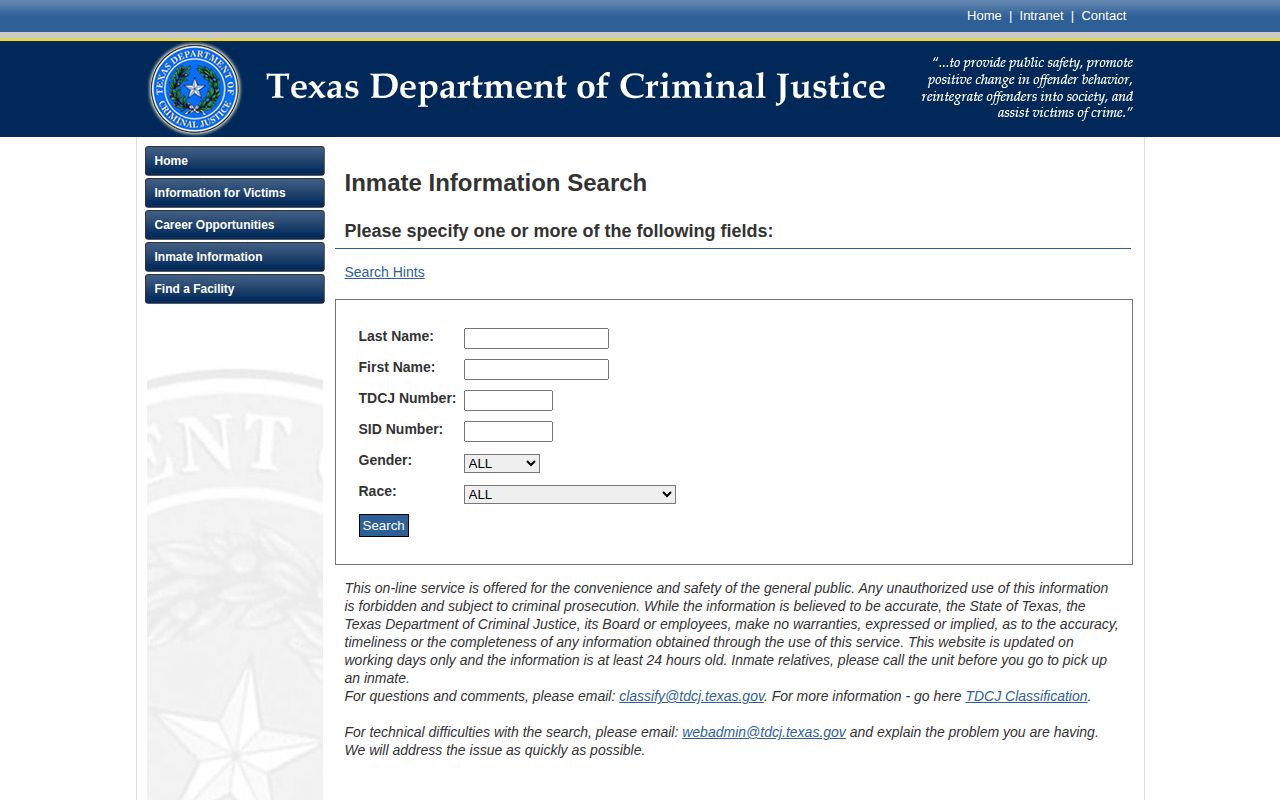
That limit is crucial. A blank result cannot prove release, while a matched record confirms that state incarceration continues.
The Wilbarger County release lookup covers the jail and court trail when the outcome is uncertain.
Texas Good Time for Wilbarger
Texas Government Code §498.003 makes good-conduct time relevant to parole or mandatory-supervision eligibility. It does not otherwise shorten the sentence imposed by the court. Good time is a privilege, not a right. TDCJ may award it based on eligible participation and classification, and credits may be forfeited.
Current rates include twenty days for each thirty days served for trusty and Class I classifications, plus as many as ten extra trusty days. Class II receives ten days per thirty. Class III earns none while in that class. Those figures do not support a do-it-yourself release calculation. Offense date, eligibility, sentence sequence, jail credit, classification, Board action, and holds all matter.
- Flat time
- Calendar time actually served, without good-conduct credits.
- Good-conduct time
- A credit affecting an eligible threshold but not erasing the sentence.
- Parole eligibility
- The earliest point for possible review, not a promised release.
- Mandatory supervision
- Release under supervision when statutory and Board requirements are met.
Note: Wilbarger jail and court records control local computations because TDCJ classifications do not govern every county sentence.
No Texas 85 Percent Rule
Texas has no universal state-prison rule requiring every person to serve 85 percent. Federal truth-in-sentencing shorthand should not be imported into a Wilbarger case. Under Government Code §508.145, many ordinary cases may reach parole eligibility when calendar time plus good conduct equals one-fourth of the sentence or fifteen years, whichever is less, subject to the offense date and statute.
Listed serious offenses, historically called “3g” offenses, generally require calendar time equal to one-half of the sentence or thirty years, whichever is less, with minimums and special terms. Good time does not reduce that flat-time threshold. Capital, specified aggravated sexual, trafficking, and other offenses can have special or excluded rules. Section 508.149 governs mandatory-supervision exclusions.
Amendments attach to offense dates. A sound estimate needs the judgment, offense date, sentence order, jail credit, classification data, and agency computation. Eligibility remains a review point rather than a release date.
Why Wilbarger Release Dates Change
TDCJ recalculates as legal and administrative facts change. A later date does not by itself mean a new sentence, and an earlier one does not prove release processing is complete.
| Factor | Possible effect |
|---|---|
| Classification or good-time loss | Changes credits used for an eligible threshold. |
| Board denial or later approval | Can move a discretionary projection to maximum expiration or earlier for processing. |
| Parole panel action | Approval, denial, or required programming can alter timing. |
| Court order or jail-credit correction | Changes the legal inputs used in the calculation. |
| Consecutive sentences | Requires another term or sequence to be counted. |
| Detainer, hold, or new charge | May block community release or cause transfer. |
A detainer is a notice from another authority concerning custody. Leaving TDCJ or Wilbarger custody can therefore lead to another custodian instead of the community. Ask for the destination as well as the date.
Three Texas Release Date Branches
TDCJ definitions describe three paths. For a mandatory-supervision-eligible offense before September 1, 1996, the projection is when flat time plus good-time credits equal the sentence. For an eligible offense on or after that date, it is the prospective discretionary mandatory-supervision date when flat plus good time equal the term and the Board approves.
If the Board denies that post-1996 release, TDCJ recalculates to maximum expiration. A later approval can move the date earlier for processing. When an offense is not eligible for mandatory supervision, projected release is maximum expiration, with flat time completing the term unless parole occurs sooner.
The TDCJ definitions display documents these branches.
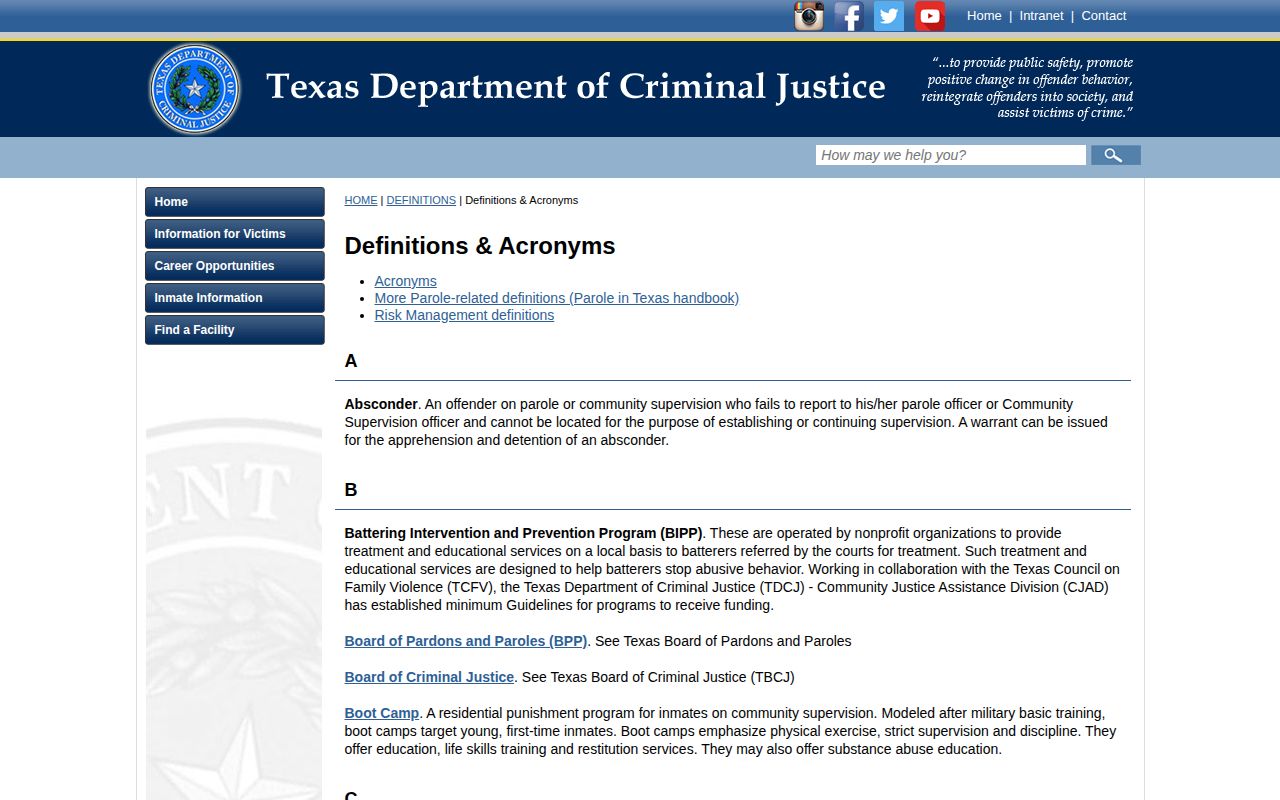
This is why one field can move from a prospective mandatory date to maximum expiration and back toward processing after later approval. Only the completed event record proves release.
Wilbarger Parole Dates Are Different
Parole eligibility, Board review, a favorable vote, scheduled release, actual prison release, and discharge are separate milestones. Eligibility only means that a case can be considered under the governing law. It does not compel a favorable vote. A favorable vote may still require a program, an approved plan, or other processing before TDCJ schedules departure. After release, the Wichita Falls District Parole Office may supervise a Wilbarger case until the sentence or supervision term ends.
A parole or mandatory-supervision status confirms that state-prison confinement ended into supervision. It does not mean the full sentence is over. The later discharge date answers that separate question. When contacting TDCJ, use the precise term needed: review status, parole-release status, actual release date, supervision status, or discharge date. Asking only for a “release date” can yield a projected field when the goal is to confirm a completed event.
The Wichita Falls District Parole Office serves Wilbarger County from 3100 Seymour Highway, Suite 118, Wichita Falls, TX 76301. Its phone is (940) 322-2721. Provide the person's full name plus TDCJ or SID number, or date of birth, and ask whether the person is currently supervised and which office holds the case.
Request Wilbarger Release Date Records
Once a person leaves the public TDCJ search, the strongest route is a post-event record rather than an inference from the blank screen. A TDCJ Public Information Act request can identify the person and seek the actual release or discharge date, release type, release unit or location, conviction county and court, parole or mandatory-supervision status, and discharge date. Those fields distinguish physical release from the later end of supervision.
For a Wilbarger County Jail sentence, direct the request to the sheriff because that office keeps the booking and release event. Court judgments and later orders belong with the proper clerk. A felony judgment is held by the Wilbarger District Clerk. County-court proceedings go to the County Clerk. Ask for existing records with a clear date range and person identifier rather than asking an office to calculate a new forecast.
Texas Government Code Chapter 552 governs access to held public information, but lawful exceptions and redactions can apply. A narrow request helps identify the right event while respecting those limits. The record's source also matters: the sheriff cannot certify a TDCJ discharge, and TDCJ cannot supply a county bond-release event that occurred before state admission.
Confirm Wilbarger Inmate Release Dates
For current TDCJ custody, send the full name and seven-digit TDCJ number to pia@tdcj.texas.gov. If the number is unknown, provide the exact birth date or approximate age and conviction county. TDCJ says this route can supply location, offense history, and projected release date without charge. It does not supply photographs.
Telephone information is available from 8 a.m. to 5 p.m., Monday through Friday, at (936) 295-6371 or (800) 535-0283. Parole-review status before a Board vote uses (844) 512-0461. After a favorable vote, parole-release status goes through TDCJ Parole Division at (512) 406-5202. Provide a TDCJ number, SID, or exact birth date.
Register through IVSS for TDCJ notices. The separate Wilbarger County VINELink release check applies to participating local data. When a person disappears from the TDCJ search, request the actual release or discharge date, type, unit, and supervision status.
Note: Release into parole or mandatory supervision ends prison confinement but does not mean the term has been discharged.
Public Record Search
Sponsored Results